

Cybersecurity assessment for SMEs: measure your risk in 10 minutes
Know where you stand on cybersecurity basics, and what to fix first, without technical expertise.
What is a cybersecurity assessment for an SME?
A cybersecurity assessment for an SME is a quick evaluation of your protection practices (access, backups, updates, training, suppliers). It measures your risk level and shows what to fix first. Unlike a technical audit, it needs no expertise and relies on simple questions.
Why are SMEs targets for cyberattacks?
SMEs often have fewer resources dedicated to security, which makes them easier targets than large organizations. Phishing, ransomware and data theft are common. An incident can also trigger reporting obligations under Law 25.
What the numbers say
Statistics Canada
- In 2023, 16% of Canadian businesses were affected by a cybersecurity incident (18% in 2021, 21% in 2019).
- In 2023, more than 1 in 8 affected businesses (13%) reported being victims of ransomware attacks, up from 11% in 2021.
- Spending on recovery after an incident doubled, from about $600 million in 2021 to $1.2 billion in 2023.
- Just over 1 in 4 Canadian businesses (26%) had written cybersecurity policies in place in 2023.
Canadian Survey on Cybersecurity and Cybercrime, published October 21, 2024. Impact of cybercrime on Canadian businesses, 2023(opens in a new tab)
KPMG Canada
- 63% of the Quebec SMEs surveyed suffered a cybercriminal attack in the past year.
- 74% consider their systems obsolete and vulnerable.
- 58% have no ransomware response plan.
Survey conducted from August 30 to September 25, 2023 among 154 Quebec SMEs, press release of October 24, 2023 (in French). Cybercrime hit more than six in ten Quebec SMEs(opens in a new tab)
Where should an SME start to improve its cybersecurity?
Start with an assessment to identify your gaps, then cover the basics: multi-factor authentication, tested backups, regular updates and staff training on phishing. Mitabi prioritizes these actions according to your risk level.
- 1
Two-factor authentication and passwords
Add a second verification step at sign-in and protect accounts with strong passwords.
- 2
Regular, tested backups
Back up your data regularly and check that you can actually restore it.
- 3
Security updates
Apply the patches for your systems and software as soon as they are available.
- 4
Access management
Give each person the access they need, and remove it when an employee leaves.
- 5
Phishing awareness
Train your staff to recognize fraudulent emails and messages.
- 6
Supplier security and cyber insurance
Assess the security of your suppliers and subcontractors, and check your cyber insurance coverage.
What does the Mitabi assessment cover in cybersecurity?
The Mitabi assessment includes a section on cybersecurity basics: authentication, backups, updates, access management, phishing and suppliers. This section is part of the 25-question questionnaire, which also covers Law 25 and AI governance. You get a cybersecurity score and prioritized recommendations.
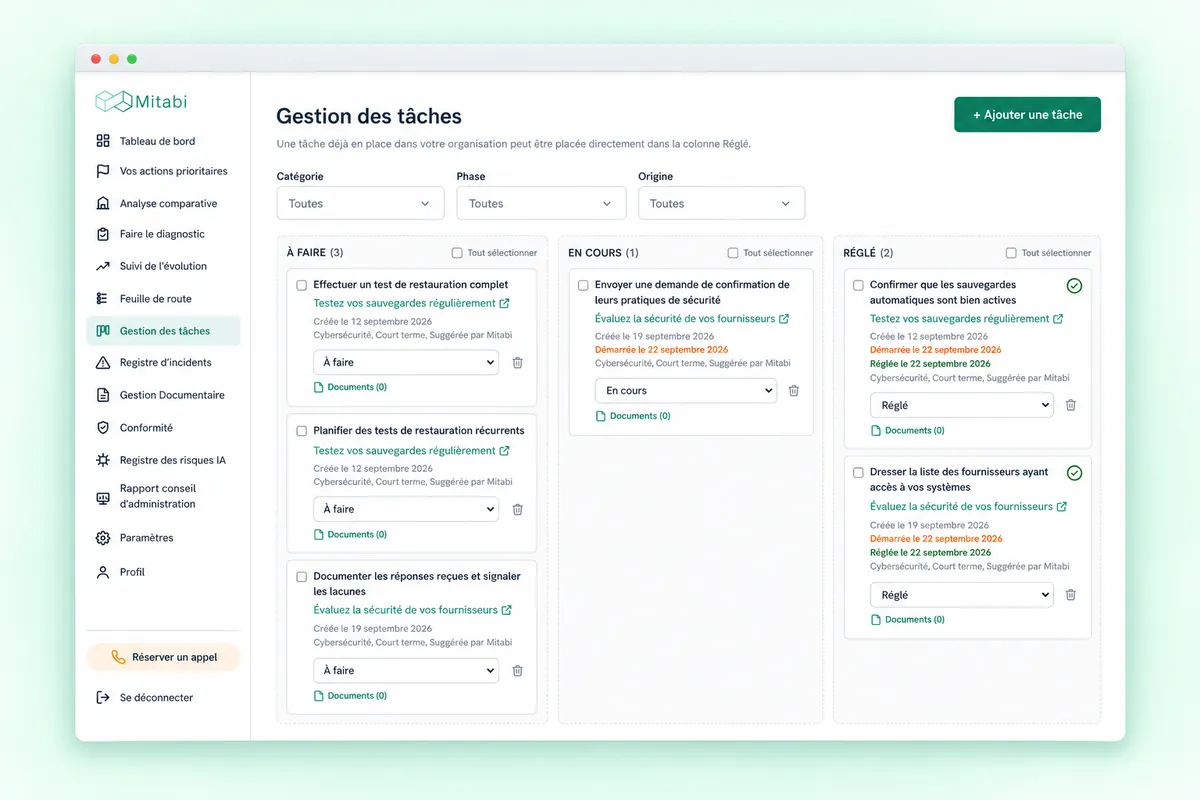
Examples of Mitabi recommendations
- Test your backups regularly: A backup that has never been restored is only a hypothesis, not a guarantee of continuity.
- Assess the security of your suppliers: A supplier with access to your systems or data can become the entry point for an attack.
Does Mitabi replace a security audit or legal advice?
No. Mitabi is a self-assessment: it identifies your risks and priorities, but it does not replace a technical audit, a certification or legal advice. It is a starting point to know what to address first before you invest.
Frequently asked questions about the Mitabi cybersecurity assessment
Yes. The Freemium plan includes the 25-question questionnaire, your maturity score, the risk radar by category, a downloadable PDF report and 5 priority recommendations. There is no commitment: you decide afterwards whether to go further.
Most owners complete the 25-question questionnaire in about 10 minutes. No preparation or appointment is needed, and your score is calculated instantly.
The assessment is free (Freemium plan, $0). For ongoing tracking, the Pro plan costs $39 per month and the Premium plan costs $99 per month. Prices are in Canadian dollars. You can start for free and change plans as your needs grow.
You receive your score and prioritized recommendations. If you want help implementing them, you can be connected with a Mitabi expert. You can also move to the Pro or Premium plan to track your progress over time.
Ready to know your risk level?
Take the assessment for free and discover your priorities in just a few minutes.
Take the free assessment